
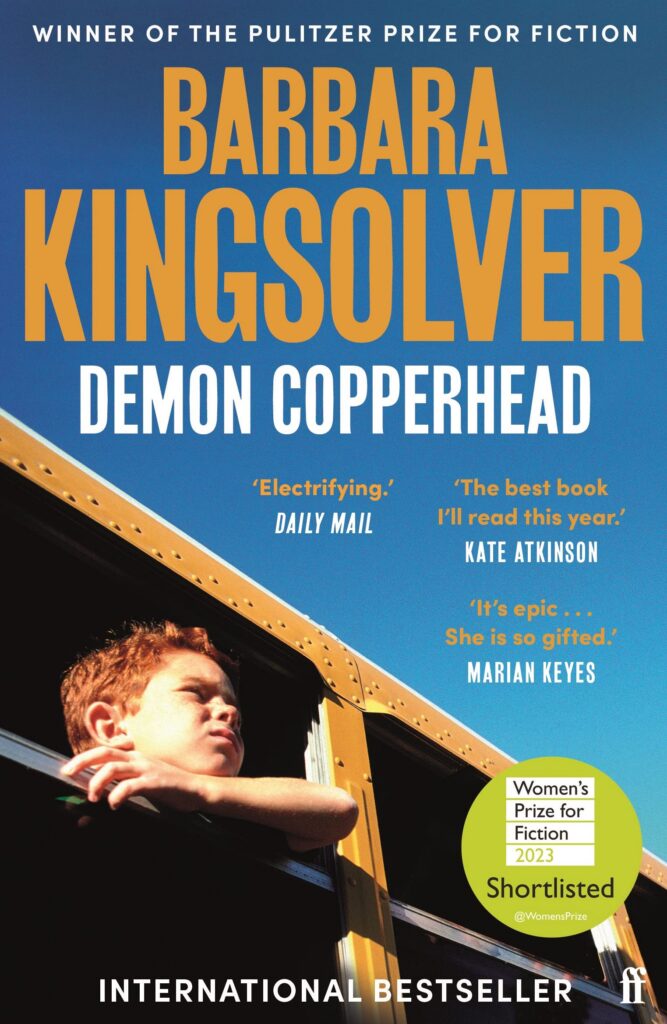
Demon Copperhead
Barbara Kingsolver
If you’re planning to add an end-of-summer read to your list and enjoy long, odyssey-like novels, Demon Copperhead is the book for you. A cinematic survivor’s story, this novel echoes David Copperfield not just in title, but also in the existential scope of its protagonist. But do expect a more juvenile take when reading Demon Copperhead.
Set in the challenging Virginia landscape, the narrative serves as a testimony to its harshness: born into systemic abandonment, Demon is unfortunate enough to experience nearly every struggle life can offer — though the story is not without glimmers of hope, joy, and connection.
Throughout his hardships, Demon’s voice blends cynicism with self-reliance — an attitude that, to me, echoes the archetypal American (male) anti-hero. I couldn’t help but hum in my mind the intro to “True Detective” whenever I restarted reading and imagine how Demon might just be a young Rustin Cohle.
The writing style is robust and engaging, preparing you for what is essentially a tour de force into the heart of 1990s neglected America. However, while the narrative has a broad, almost anthropological feel, I sometimes felt it lacked depth. Over the course of 550 pages, Demon seems to maintain the same level of introspection. That said, it fits the format and straightforwardness of a memoir. And what I really appreciated was the subtle thread of lyricism (specific to a coming-of-age story) that was weaved into his journey from hopelessness and total vulnerability to resilience and connection.
A bit of a long shot, but I’d place Demon Copperhead in the same aesthetic category as films like The Florida Project and perhaps even August: Osage County (both of which I really recommend). Both are perfectly suited for the long days of August — especially when it feels like CERN is waiting for everyone to come back from vacation.